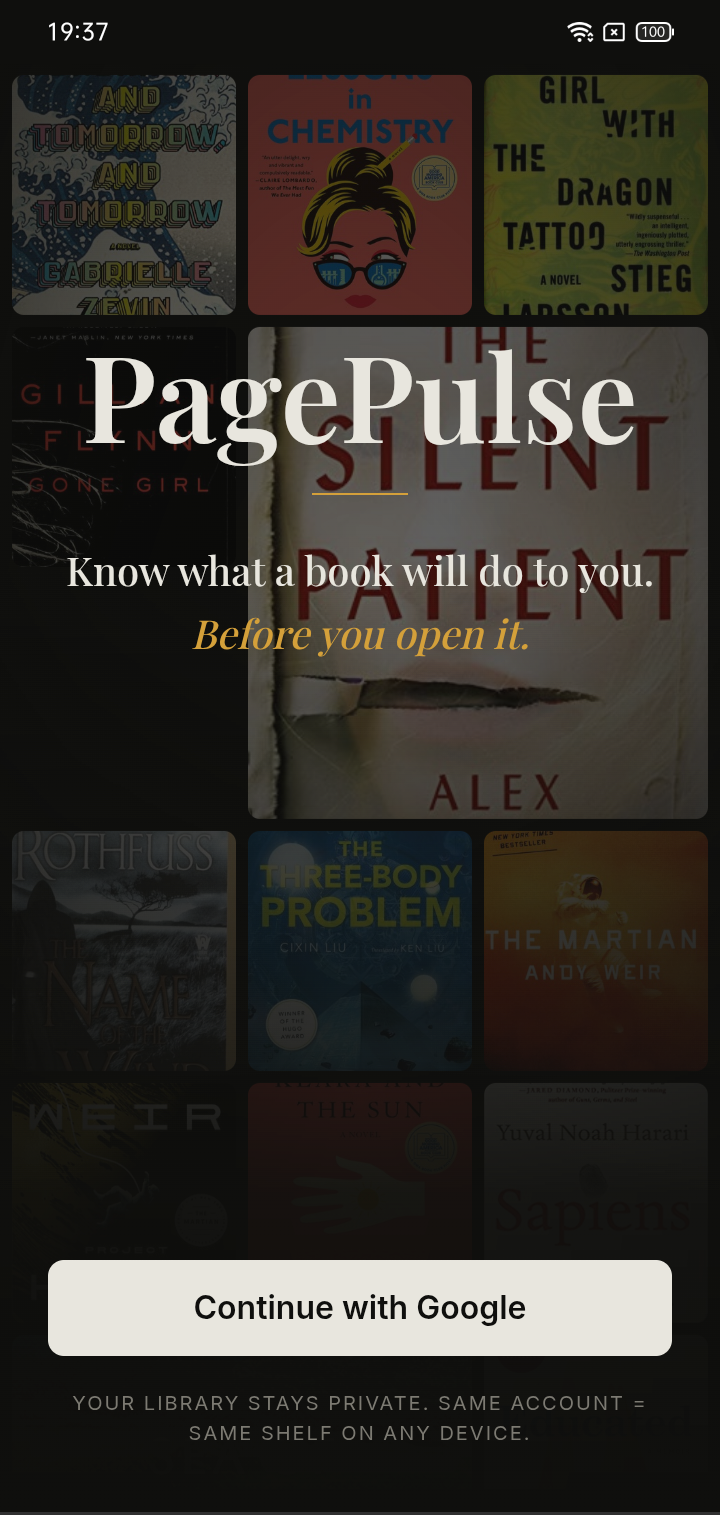
Know what a book will do to you. Before you open it.
Photograph any bookshelf. See the emotional fingerprint of every book on it. Watch what your library quietly says about you. Then read what it asks for next.
“Reading lists tell you what someone has read. PagePulse tells you what those books did to them.”— Shandar Junaid, founder
From the founder
I made PagePulse because every reading app I have tried treats books as a to-do list.
Star ratings. Read / Want to Read / Currently Reading. Genre tags. They tell you what someone has read. They cannot tell you what those books did to that person — what residue stayed, which chapter changed something, what kind of reader emerges from a particular shelf.
PagePulse is the app I have wanted for fifteen years and never found. So I built it.
— Shandar Junaid, Bengaluru · 2026
- Fear
- Sadness
- Joy
- Anger
- Hope
Photograph any bookshelf. Read the room.
Point your camera at any shelf — your own, a friend's, a stranger's at a café. PagePulse reads every spine, looks each title up, and gives you back one composite Shelfie: a single artifact that says what this whole shelf feels like. Around ten seconds, start to finish, on a modest Wi-Fi connection.
Every book gets its own fingerprint.
Every chapter is plotted across five emotions — fear, sadness, joy, anger, hope. From that chapter-by-chapter shape come six book-level metrics — the vocabulary PagePulse uses to describe what a book is.
- Pulse0 — 10
- The headline number. Overall emotional intensity. Below 3 is contemplative and slow; 6 — 8 is propulsive; 9 and above is relentless.
- Darkness0 — 100
- Concentration of fear, sadness, and anger across the book. Beloved sits high. A Gentleman in Moscow sits low.
- Tension0 — 100
- How taut the pacing is — how rarely the book lets you exhale.
- Hope0 — 100
- Uplift across the chapters. Not optimism — the genuine concentration of hope-coloured passages.
- Complexity0 — 100
- How many emotional threads run at the same time. A high-complexity chapter moves between fear and joy in the same paragraph; a low one stays in one register.
- Volatility0 — 100
- Chapter-to-chapter swing. Calm pacing or whiplash.
A Gentleman in Moscow has a different pulse than Beloved, and the reader who finishes both is making a deliberate choice about who they want to be that month. PagePulse gives that choice a vocabulary.
Your library, reading you back.
The shape of your taste, surfaced in one screen. After fifty books PagePulse will tell you whether you quietly became someone who finishes things or someone who picks up the next one — and which kind of book is most likely to break the pattern. Every morning, a fresh pick lands at the top of Discover, matched to that shape, with the reason it earned its place.
Bring your library, however you keep it.
Already have a reading life on Goodreads, StoryGraph, or a spreadsheet you've kept for years? Drop the CSV in. PagePulse reads it, looks every title up against a live catalog of millions of books, and pulls in real covers, ISBNs, and metadata as it goes.
- Photograph it. Point your camera at a shelf — Shelfie reads the spines and adds the books.
- Import from Goodreads. Built-in export instructions; the file works as-is.
- Import from StoryGraph. Same flow — your CSV, your books.
- Or any CSV. Title and Author columns are enough — the app does the rest.
Every imported book gets the full PagePulse treatment — fingerprint, pulse, persona signal — as if you'd added it by hand.
One price. Yours forever.
A paid app. No subscription, no ads, no add-ons. A hardback in India costs about the same; PagePulse pays for itself the first time it saves you from a wrong recommendation.
- Unlimited Shelfies
- Unlimited book analyses
- Reading persona + patterns
- Personalised daily picks
- Cross-device library sync
- Delete account & data, anytime
- Unlimited Shelfies
- Unlimited book analyses
- Reading persona + patterns
- Personalised daily picks
- Cross-device library sync
- Delete account & data, anytime

One tap to sign in. Same shelf on any device.
Google or Apple Sign-In on first launch — no email/password, no anonymous trial, no "save your stuff before it fades" nag. The app you paid for is yours, your library is yours, and so is the off-switch.
Frequently asked.
The questions that come up most often. Not here? Write to hello@affordancedesign.in — we read every one.
How does PagePulse know what a book will do to me?
For public-domain works, the analysis reads the actual text chapter by chapter. For in-print books, it works from careful inference — title, themes, reviews, the author's wider corpus — to produce the same emotional fingerprint shape. Either way you get the chapter-level chart, pulse, darkness, hope, complexity, and a verdict card before chapter one.
How accurate is the emotional fingerprint?
It's a directional read, not a science. Two careful human readers wouldn't agree on a book's pulse score to one decimal place, and PagePulse doesn't either. What it does well: surface emotional shape, flag what you're about to feel, and find adjacencies in your library. Treat it like a literate friend who has read everything — opinionated, sometimes wrong, always useful as a starting point.
Is my data private?
Your library, analyses, and reading patterns live in Google Firebase under your Google account. We never sell user data, never share it with advertisers, and the app contains no ads. AI providers receive book content for analysis but not your account or library. Camera images for Shelfie scans are processed in memory only and never stored. Full details at thepagepulse.com/privacy.
What does the Shelfie scan need to work?
A bookshelf with at least three or four spines visible, decent lighting, and a steady frame. PagePulse reads each spine, looks the titles up against a live catalogue of millions of books, and pulls in real covers and ISBNs and metadata as it goes. Best results when spines are vertical, text is readable, and you're close enough that spines fill at least a third of the frame.
What if PagePulse misidentifies a book on my shelf?
Tell us. The Books API search isn't perfect — substring matches sometimes win over exact ones. After a scan, every detected book appears in your library; tap any wrong one and remove it. If you see the same misidentification pattern repeatedly, email hello@affordancedesign.in with the spine description and what got returned — that's how the ranking heuristic improves.
Can I use PagePulse offline?
Reading your existing library — yes. Browsing your patterns, opening a book detail you've already analysed, looking at recommendations — yes. The two things that need a connection: Shelfie scans (computer vision runs server-side) and book analysis (also server-side). The app surfaces a clear offline prompt when these are attempted without a network.
How do I import my Goodreads or StoryGraph library?
Library tab → Import CSV. Goodreads: Account → Export Library → download the CSV. StoryGraph: Settings → Export → download CSV. Either file works as-is — PagePulse reads it, looks every title up against the catalogue, and queues analysis for each book. A library of 200 books typically completes its initial analyses overnight.
How often are For You recommendations updated?
Once daily, generated around midnight UTC based on your library state at that moment. Pulse, persona, and recent additions all feed in. If you add 30 books today, you'll see noticeably different recommendations tomorrow morning.
What happens when I delete my account?
All your library, analyses, recommendations, and persona data are removed from our servers permanently within seven days (usually within minutes). The Firebase Auth record goes too. The app on your device clears its local cache and returns to the sign-in screen. Books in the shared catalogue stay — those aren't personal data.
Which platforms is PagePulse on?
iOS and Android. Same account, same library, same analyses — sign in with Google or Apple on either platform and your shelf follows you.
Refunds?
Refunds are handled by the store you purchased from. On Google Play: within 48 hours via the Play app (My orders → tap the order → Refund), up to 7 days via Google Support. On the App Store: via reportaproblem.apple.com. Beyond those windows it's at the store's discretion.